Flow is a state of complete immersion & focus in an activity, leading to enhanced performance & satisfaction.
Achieving flow requires a balance between skill level & challenge, which fosters full engagement & motivation.
Encouraging environments that support concentration & clear goals can help individuals experience flow more often.
Have you ever lost yourself in an activity so completely that hours felt like minutes?
Perhaps you’ve experienced it while painting, playing a sport, or diving into a complex project at work. You were immersed, energized, and performing at your best.
Welcome to flow.
As a trauma therapist, I experience flow with clients during those powerful moments when someone begins to challenge long-held beliefs, confront fears, and stretch beyond their comfort zone. Time seems to blur in these sessions.
Flow is not a constant or easily accessible state, as much as we wish it were. Flow requires specific conditions. It often eludes us as soon as we become aware of it. Perhaps by understanding it more, using the context of positive psychology, we can recognize its presence and intentionally activate it in our lives.
Before you continue, we thought you might like to download our five positive psychology tools for free. These detailed, science-based exercises will help you or your clients become more productive and efficient.
What Is Flow in Positive Psychology? (Meaning + Definition)
Flow is a state where you are so immersed in an activity that you lose track of time, self-consciousness fades, and you feel a deep sense of purpose and enjoyment. We often identify this as the “optimal experience.”
What exactly makes the experience of flow so powerful and so distinct from ordinary concentration or enjoyment? There are specific psychological conditions that define the flow state.
8 key characteristics of the flow experience
Flow is now understood to involve eight core characteristics that help explain why it feels so effortless, energizing, and transformative (Cherry, 2025).
Characteristics of flow include:
Merging of action and awareness
The boundaries between the self and the activity dissolve, which creates a sense of unity.
Concentration on the task at hand
Intense focus eliminates distractions and enhances performance.
Loss of self-consciousness
There’s no room for self-doubt or external judgments because you’re fully immersed in the moment.
Altered sense of time
Time may speed up or slow down, reflecting your deep engagement.
Sense of control
You feel capable and confident even in challenging situations.
Autotelic experience
The activity becomes intrinsically rewarding, regardless of external outcomes.
Balance between challenge and skills
The task perfectly aligns with your skill level while offering just enough challenge to stay engaging without causing overwhelm.
Effortlessness and fluidity of performance
Actions feel natural and unforced, and seamlessly flow from one to the next.
9 crucial preconditions for flow
Flow doesn’t happen by accident. Several preconditions must align to foster this optimal state (Flow Centre, 2023):
Challenge–skill balance
The task must be challenging enough to engage your skills without overwhelming you.
Clear goals
Knowing what you’re working toward provides focus and direction.
Immediate feedback
Real-time feedback allows for adjustments and keeps you engaged.
Autotelic intent
The activity should be rewarding in itself and nurture intrinsic motivation.
Sense of control
Feeling in control of your actions helps sustain flow.
Conducive environment
A supportive and distraction-free setting enhances your ability to focus.
Alignment with personal values and interests
Engaging in activities that resonate with your core values fosters deeper involvement.
Clear rules and structure
Defined parameters provide a framework for immersion.
Autonomy
The freedom to make decisions and shape your experience is essential.
Flow invites us into moments where challenge meets capability and presence replaces distraction. Understanding what flow is, how it feels, and the conditions that give rise to it allows us to intentionally create more opportunities for this optimal state in our daily lives.
4 examples of flow-inducing activities
Flow can emerge in nearly any activity when the right balance of challenge and skill is present.
Artists often describe losing all sense of time while painting, composing music, or writing, all of which are creative pursuits that demand full immersion and continuous feedback.
Athletes frequently access flow states during moments of intense physical engagement, such as rock climbing, long-distance running, or surfing, where their attention is directed on the task and their environment.
In professional settings, flow can arise while solving complex problems, being inspired by work, or delivering a compelling presentation. For me, engaging in meaningful work with clients stretches my abilities just enough to inspire growth without causing overwhelm.
Even hobbies and games, from gardening and cooking to chess and video games, can induce flow when they provide structured challenges that absorb attention and offer clear goals.
What ties all these diverse flow activities together? It is their capacity to fully engage us in a way that quiets our inner chatter, helps us focus easily, and invites complete presence.
For more information on creating this optimal experience, check out this video, “Fear or Flow.”
Fear or flow: How to create an optimal experience
The flowchart
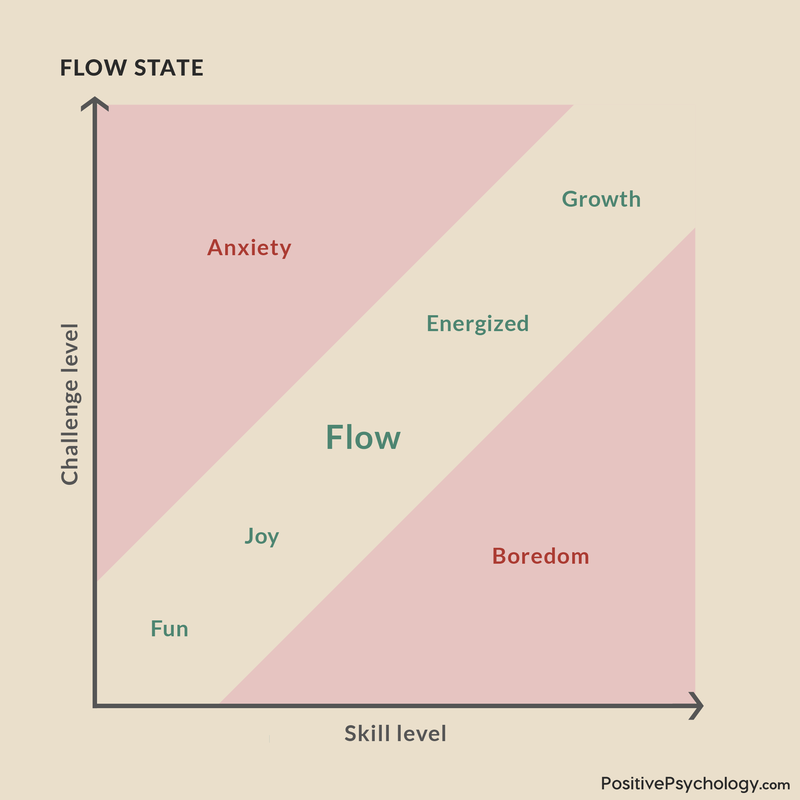
Flow arises from the dynamic balance between perceived challenge and personal skill.
Different combinations of skill and challenge produce distinct psychological states (Gold & Ciorciari, 2020):
When both are low, individuals tend to feel apathetic.
When skills are high but the challenge is minimal, boredom sets in.
When the challenge exceeds perceived ability, anxiety is likely to arise.
The magic of flow occurs when both skill and challenge are high. This is a state in which individuals are stretched to the edge of their capabilities but not overwhelmed. This channel of flow represents the optimal point of engagement, where the experience becomes intrinsically rewarding (Csikszentmihalyi, 1990).
Subsequent research has supported this model, emphasizing that the perception of both competence and growth opportunity is essential for entering and sustaining flow (Engeser & Schiepe-Tiska, 2012).
By understanding this balance, professionals and interested individuals alike can more intentionally create environments that support optimal functioning.
Flow State
The Flow Theory of Optimal Experience Explained
We know that the most fulfilling moments in life occur when we are fully immersed in a challenging yet rewarding activity (Csikszentmihalyi & Nakamura, 2010). We also know that flow offers a state of deep absorption where time vanishes, self-consciousness disappears, and effort feels effortless.
Modern neuroscience has shed light on why flow feels so immersive and rewarding. Rather than being just a subjective experience, flow is underpinned by distinct neurological shifts that enhance performance, creativity, and emotional wellbeing (Harris et al., 2017; Ulrich et al., 2016).
One key discovery is the phenomenon of transient hypofrontality, which is believed to be responsible for quieting the inner critic and the parts of the brain that typically govern self-consciousness and deliberation (Dietrich, 2004).
At the same time, the default mode network (active when our minds wander or dwell on the ego) powers down, making it easier to stay fully absorbed in the task (Ulrich et al., 2016).
Meanwhile, the salience network, the brain’s internal filter for prioritizing our attention, intensifies and assists us in focusing on the most important aspects of the moment (Harris et al., 2017).
Besides these brain changes, flow unleashes a powerful mix of feel-good neurochemicals that help keep us in the zone (van der Linden et al., 2021).
Dopamine boosts motivation and provides us that pleasurable sense of reward for staying engaged.
Norepinephrine sharpens our focus and enhances alertness, helping us respond quickly and perform at our best.
Endorphins add a natural high that eases discomfort and often gives experiences a euphoric quality.
Anandamide, a neurotransmitter linked to creativity and lateral thinking, opens the door to new insights and problem-solving.
All together, these brain and body shifts help explain why flow feels so good and why we often do our best, most meaningful work when we’re in it.
Important research findings
A growing body of research confirms that flow has profound implications for performance, learning, subjective wellbeing, and even our connection to the world around us.
In high-performance domains like sports, athletes in flow demonstrate faster reaction times, greater endurance, and elevated levels of focus that lead to peak performance outcomes (Harris et al., 2021; Swann et al., 2012). In the workplace, flow is strongly linked to increased productivity, creativity, and overall job satisfaction (Engeser & Schiepe-Tiska, 2012).
In educational settings, flow has been shown to foster deeper student engagement and longer-lasting knowledge retention. When students experience flow during learning activities, they are more likely to stay motivated, show resilience in the face of difficulty, and master new skills (Heutte et al., 2016).
Still, the benefits of flow aren’t limited to performance and achievement settings.
Flow also sharpens and uplifts our spirit. Psychological research has consistently found that individuals who experience flow regularly report greater happiness, higher self-esteem, and increased life satisfaction (Csikszentmihalyi & Nakamura, 2010). Isn’t that what it’s all about?
The immersive nature of flow provides people a sense of purpose, helping to reduce our stress and promote emotional wellbeing.
Recent findings highlight that flow is often enhanced when the activity occurs in environments that hold personal meaning, such as in nature, creative spaces, or culturally significant places. Steele and Brown (2020) suggest that flow could enhance our connection to the physical and emotional environments in which we live and act.
Download 5 Free Positive Psychology Tools
Start thriving today with 5 free tools grounded in the science of positive psychology.
Download Tools
Flow & Happiness: 7 Benefits
No surprise here, but it is important to note that the relationship between flow and happiness is interconnected. While happiness often stems from emotional expression and intentional action, flow emerges from deep focus and immersion in meaningful activities. Together, they create a structured pathway to fulfillment.
There are seven key benefits of flow that contribute to greater happiness and life satisfaction (The Pursuit of Happiness, 2024).
1. Flow provides a sense of direction and meaning
Engaging in flow states helps us identify goals that inspire creativity and personal growth.
Having clear objectives, whether in work, hobbies, or personal development, fuels motivation and provides a sense of purpose, both of which are essential to happiness.
2. Flow enhances organization and productivity
Because flow thrives on structure and clear goals, it encourages us to develop a strategic approach to tasks. This ability to break down big tasks into manageable steps promotes progress, confidence, and a sense of accomplishment.
3. Flow increases mindfulness and presence
A defining characteristic of flow is complete immersion in the present moment. Distractions fade, and we become deeply engaged in our activity.
This heightened state of focus reduces stress and anxiety, making it easier for us to find joy in the process rather than just the outcome.
4. Flow strengthens self-belief and motivation
The way we talk to ourselves plays a crucial role in sustaining both flow and happiness. Flow naturally encourages a positive inner dialogue that reinforces our ability to stay committed, overcome obstacles, and push through setbacks. Instead of being bogged down by self-doubt or external judgments, flow allows us to trust our instincts and feel more in control of our actions.
5. Flow encourages healthy and productive habits
The more we experience flow, the more we develop patterns of engagement that lead to success. By making flow a regular part of our daily life, we build habits that foster discipline, creativity, and resilience.
6. Flow supports mental restoration and self-reflection
While flow is an energizing experience, rest and recovery are equally important for sustaining happiness. Taking breaks, meditating, and allowing time for self-reflection provide mental clarity and emotional balance. By periodically stepping back to reflect, we can enhance our ability to reenter flow with renewed energy and focus.
7. Flow cultivates lasting joy and fulfillment
Flow fosters a sense of deep satisfaction in the journey, not just the destination. It helps us to celebrate small wins along the way. When you embrace the present moment and acknowledge your progress, you may see an increase in gratitude, motivation, and overall life satisfaction.
The Optimal Experience in Sports & Arts
Flow plays a significant role in both sports and the arts by enhancing performance, skill development, and overall engagement.
If you are an athlete, you may notice that in your state of flow, you push past limitations and acquire new techniques with greater ease (Jackson & Kimiecik, 2008).
Similarly, flow is deeply embedded in artistic expression. If you are a painter, sculptor, writer, musician, or creator of some sort, you know what it is like losing yourself in your craft. Artists frequently enter a state of effortless focus and deep enjoyment, allowing their work to feel both intuitive and highly expressive (Cameron, 1992).
Thus, across both disciplines, we can see that flow fosters heightened concentration, intrinsic motivation, and a deep connection with the activity.
The relationship between flow, mindfulness, and meditation is complex.
Schutte and Malouff (2023) report that mindfulness can either enhance or disrupt flow depending on how it is experienced. Sometimes, mindfulness may disrupt flow by increasing self-awareness and pulling attention away from full immersion in an activity. Other times mindfulness can promote flow by reducing performance anxiety and intrusive thoughts, making it easier to stay engaged.
A meta-analysis found that a long-term mindful outlook may have a stronger positive impact on flow than momentary mindfulness (Schutte & Malouff, 2023). For example, mindfulness and meditation may help create focus, emotional regulation, and reduced self-judgment to enhance the state of flow.
Flow in Different Life Domains
Flourishing in different life areas such as spirituality, work, family, health, and community is essential for overall wellbeing. Flow plays a unique role in enhancing each of these key life domains (VanderWeele, 2017).
In the spiritual domain, flow deepens presence and introspection, enriching practices like meditation, prayer, or contemplation by anchoring us in the moment. At work, flow transforms daily tasks into sources of meaning. It drives productivity, creativity, and job satisfaction through intrinsic motivation.
Within families, shared flow experiences can look like meaningful conversations, cooperative tasks, or play. These experiences within a family strengthen bonds and foster emotional connection. Flow also supports health-related goals by making physical activity and self-care routines more enjoyable and engaging.
A big component of health-related flow is that once–difficult health goals, like running or meal preparation, become easier. In the community, flow enhances participation and purpose in social or volunteer efforts, reinforcing a sense of belonging and contribution.
Across all domains, flow serves as both a catalyst for engagement and a pathway to deeper fulfillment (VanderWeele, 2017).
4 Challenges, Criticisms & Misconceptions
Flow theory is not without limitations. One of the most cited critiques is that flow research often relies on self-reported data, which can be prone to bias and limit the objectivity of findings (Harris et al., 2021; Newcastle University, 2025).
Additionally, the theory tends to underemphasize the role of individual personality traits and intrinsic motivation, both of which play a critical role in whether and how people access flow.
Another challenge is the lack of defined, context-specific strategies to reliably induce flow. Counselors would benefit from strategies and techniques to use with clients that directly promote flow. These techniques would also be advantageous for teachers facilitating a classroom of students. However, that is an under-researched area.
Finally, researchers continue to struggle with experimentally inducing flow in controlled environments, which complicates efforts to draw definitive conclusions about its causal impact on performance. These limitations point to the need for further refinement of the theory and more studies moving forward.
3 Books on the Flow State
For those looking to deepen their understanding of flow, several influential books offer both foundational theory and practical insights. These titles explore how flow enhances performance, creativity, and wellbeing across diverse fields and disciplines.
1. Flow: The Psychology of Optimal Experience – Mihaly Csikszentmihalyi
This book, the foundational text on flow theory, explains how people achieve peak performance and fulfillment when deeply immersed in an activity.
Csikszentmihalyi explores the science of flow, its psychological benefits, and how to cultivate it in work, sports, and creative pursuits.
2. Stealing Fire: How Silicon Valley, the Navy SEALs, and Maverick Scientists Are Revolutionizing the Way We Live and Work – Steven Kotler & Jamie Wheal
This book explores altered states of consciousness, including what flow is and how it drives breakthrough performance in business, technology, and elite training programs.
Kotler and Wheal discuss practical strategies, neurobiology, and innovations that make flow more accessible.
3. The Art of Impossible: A Peak Performance Primer – Steven Kotler
A New York Times best seller, this book is a practical guide to mastering flow and peak performance, blending neuroscience, psychology, and real-world case studies to help readers push past limits.
Kotler provides step-by-step methods to develop focus, motivation, and resilience in pursuit of ambitious goals.
Whether you’re seeking peak performance, greater focus, or deeper fulfillment, these books offer compelling roadmaps grounded in science and experience. Each provides unique tools and perspectives for intentionally accessing the flow state in everyday life.
17 Exercises To Become Productive & Efficient
Use these 17 productivity and work efficiency exercises [PDF] to help others prioritize better, eliminate time wasters and maximize their personal energy.
While it may seem elusive, understanding the conditions that foster flow can help you cultivate more immersive experiences daily.
How might you help your clients understand what flow is and identify or build flow into their routines? Start by exploring intriguing challenges that push their limits and eliminate unnecessary distractions, and encourage them to pursue activities that resonate with their core passions.
By doing so, they’ll enhance performance and experience a richer, more meaningful life.
Csikszentmihalyi, M., & Nakamura, J. (2010). Effortless attention in everyday life: A systematic phenomenology of “flow.” In B. Bruya (Ed.), Effortless attention: A new perspective in the cognitive science of attention and action (pp. 179–190). MIT Press.
Csikszentmihalyi, M. (1990). Flow: The psychology of optimal experience. Harper & Row.
Engeser, S., & Schiepe-Tiska, A. (2012). Historical lines and an overview of current research on flow. In S. Engeser (Ed.), Advances in flow research (pp. 1–22). Springer.
Gold, J., & Ciorciari, J. (2020). A review on the role of the neuroscience of flow states in the modern world. Behavioral Sciences, 10(9), 137. https://doi.org/10.3390/bs10090137
Harris, D. J., Vine, S. J., & Wilson, M. R. (2017). Neurocognitive mechanisms of the flow state. Progress in Brain Research, 234, 221–243. https://doi.org/10.1016/bs.pbr.2017.06.012
Harris, D. J., Allen, K. L., Vine, S. J., & Wilson, M. R. (2021). A systematic review and meta-analysis of the relationship between flow states and performance. International Review of Sport and Exercise Psychology, 16(1), 693–721. https://doi.org/10.1080/1750984X.2021.1929402
Heutte, J., Fenouillet, F., Martin-Krumm, C., Boniwell, I., & Csikszentmihalyi, M. (2016). Validation of a French version of the flow short scale (FSS) and the dispositional flow scale-2 (DFS-2). European Review of Applied Psychology, 66(6), 267–274.
Jackson, S. A., & Kimiecik, J. C. (2008). The flow perspective of optimal experience in sport and physical activity. In T. S. Horn (Ed.), Advances in sport psychology (pp. 377–399). Human Kinetics.
Schutte, N. S., & Malouff, J. M. (2023). The connection between mindfulness and flow: A meta-analysis. Personality and Individual Differences, 200. https://doi.org/10.1016/j.paid.2022.111871
Steele, C. J., & Brown, S. (2020). Music training and brain function. Frontiers in Psychology, 11, 448.
Swann, C., Keegan, R. J., Piggott, D., & Crust, L. (2012). A systematic review of the experience, occurrence, and controllability of flow states in elite sport. Psychology of Sport and Exercise, 13(6), 807–819. https://doi.org/10.1016/j.psychsport.2012.05.006
Ulrich, S., Keller, J., & Grön, G. (2016). Neural signatures of experimentally induced flow experiences identified in a typical fMRI block design with BOLD imaging. Social Cognitive and Affective Neuroscience, 11(3), 496–507. https://doi.org/10.1093/scan/nsv133
van der Linden, D., Tops, M., & Bakker, A. B. (2021). The neuroscience of the flow state: Involvement of the locus coeruleus-norepinephrine system. Frontiers in Psychology, 12, Article 645498. https://doi.org/10.3389/fpsyg.2021.645498
VanderWeele, T. J. (2017). On the promotion of human flourishing. Proceedings of the National Academy of Sciences of the United States of America, 114(31), 8148–8156. https://doi.org/10.1073/pnas.1702996114
About the author
Laura Copley, Ph.D. offers her insight on healing complex trauma as a therapist, podcast host of "Tough Love with Dr. Laura Copley", and at speaking engagements around the world. Recently, she released her first book called "Loving You is Hurting Me," a self-improvement book on trauma bonding that blends storytelling, psychoeducation, and powerful activities and strategies that lead to Post-Traumatic Growth.
How useful was this article to you?
Not useful at all
Very useful
Share this article:
Article feedback
Comments
What our readers think
Nageswara Rao Mallela
on October 17, 2025 at 04:10
Great work. It helped me to frame the concept for coaching my community.
Amazing, when you actually read the above, you get a feeling of realisation, that there is so much to life, it starts bringing out the word ‘meaningful life now’. “Now” means getting to start practicing triggers to positive flow immediately.
Great tool for management teams, great tool for meaningful decisions and a great tool to ones personal life.
 Have you ever lost yourself in an activity so completely that hours felt like minutes?

 Flow plays a significant role in both sports and the arts by enhancing performance, skill development, and overall engagement.
 Flourishing in different life areas such as spirituality, work, family, health, and community is essential for overall wellbeing. Flow plays a unique role in enhancing each of these key


What our readers think
Great work. It helped me to frame the concept for coaching my community.
Amazing, when you actually read the above, you get a feeling of realisation, that there is so much to life, it starts bringing out the word ‘meaningful life now’. “Now” means getting to start practicing triggers to positive flow immediately.
Great tool for management teams, great tool for meaningful decisions and a great tool to ones personal life.
This article was amazing, and I am so thankful to be able to have read it for free.
Great work.