What Is Marriage Psychology?
The definition of marriage is usually from a legal perspective. Marriage occurs in every status and at various educational levels.
Why do humans pursue this arrangement? Why is it important? Why not live like our relatives the bonobo or chimpanzee? What is it about marriage that garners so much attention?
Researchers from diverse disciplines are exploring this. From an evolutionary perspective, marriage is viewed as strengthening and perpetuating the species. From a sociological vantage, marriage creates bonds between and among groups. These bonds facilitate the success of the group.
Marriage psychology focuses on the couple. Researchers question every conceivable situation around marriage. For example:
- What brings two people together?
- What keeps them together?
- What breaks them apart?
- How does their union affect their wellbeing, health, and happiness?
- Are we supposed to be monogamous?
- How does having children affect the marriage bond?
- How can government actions influence the health of marriage?
- How does stress affect the relationship?
- How does a lack of intimacy affect the relationship?
- How does the person’s upbringing affect their romantic relationships?
What is the purpose of marriage psychology?
Relationships can be tricky. Within a married relationship, this is especially true. Aside from ourselves, no single person in our adult lives has as much influence on our health and wellbeing as our spouse (Robles et al., 2014).
Our partner knows us better than anyone else because of their daily proximity to us. They know our idiosyncrasies. Over time, as we get closer, we can lift each other up and bask in that warmth. The support in our married relationship isn’t easily replaced by social support (Holt-Lunstad et al., 2008).
But when things aren’t clicking, the situation can take a dive. Squabbles or all-out battles can make it difficult to let go of the hurt.
Marriage psychology offers an examination of many of the behaviors and norms that we take for granted. It also provides a solid scientific basis for addressing problems in marriage with couples counseling or therapy.
Psychological Theories of Marriage
Among several psychological theories on marriage we’ve provides a short summary of a few prominent theories of marriage.
Social exchange theory
Social exchange theory posits that there are costs and benefits in potential interactions. People analyze each situation to determine the risks and benefits.
Within a marital relationship, these are “the cyclical patterns of transactions of valued resources, tangible or intangible, between partners and the rewards and costs associated with such transactions” (Nakonezny & Denton, 2008, p. 403).
8 Elements of intimacy
When asking questions about the psychology of marriage, researchers are often curious about how couples build and maintain intimacy. But what constitutes “intimacy”?
Waring (1988) defined intimacy along eight dimensions.
- Conflict resolution: how easily couples can resolve differences of opinion.
- Affection: the degree of emotional closeness the couple expresses.
- Cohesion: the feeling that both couples are committed to the marriage.
- Sexuality: how much sexual needs are communicated and fulfilled in the marriage.
- Identity: the couple’s level of self-confidence and self-esteem.
- Compatibility: the degree couples can work and play together.
- Autonomy: how couples become independent from their families of origin and their offspring.
- Expressiveness: the degree that thoughts, beliefs, attitudes, and feelings are shared between the partners.
Duplex theory of love
Developed by Robert J. Sternberg (n.d.), this theory combines two theories together known as the duplex theory of love.
The first is a combination of three elements, intimacy, passion, and decision/commitment. The center of intimacy is the closeness, connectedness, and bond in the relationship. Think of this as the warm fuzzy feeling you have for a romantic partner. Romance, physical attraction, and sex make up the passion element of the theory.
The final part of the equation – decision/commitment – doesn’t have to happen along with the others. For example, a person could decide to love someone, but not pursue a long-term commitment. One could also commit to a relationship without admitting their love.
 There’s a lot of good news when it comes to getting and staying married.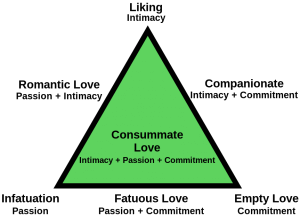



What our readers think
thanks for this article it was really help to me my difficult time . I am here today to share testimony on how love temple solution helped me brought my husband back and stop the divorce with in 48hours contact priest jaja I cant thank him enough for restoring my marriage and bring our family together again. he is capable of solving any life issues any one may be going through .etc Here is his the info. to reach him .lovetemple 0001 { @ } {g mail. {
com}
this article is very help to me ,I am here today to share testimony on how love temple solution helped me brought my husband back and stop the divorce with in 48hours contact priest jaja I cant thank him enough for restoring my marriage and bring our family together again. Here is the contact to reach him .lovetemple 0001 { @ } {g mail. {
com}
When couples decide to have children, we say that both have to want to have them, or we can’t go forward. Your son who lives with you needs to be launched. He may remain out of an unconscious belief that he needs to protect you, stay by your side, & not abandon you. You may feel you’re abandoning him by encouraging him to leave the nest. His leaving will help everyone.
Loved your article; lots of great information.
My husband is a blamer and a complainer..not about me (at least not most of the time); he complains about my son (age 25, ADHD) who is a working and contributing member to our household. He is bright, loving, and family-oriented. Unfortunately, my husband can only see what my son does not do. Husband comes from a military background. Son is working on launching from home…but financially (as it has become the norm regarding today’s economic scene) it has been prohibitive. I will also mention that my son is mine from a previous relationship. I have been in the relationship for 5 1/2 years and have been totally committed to making things work. Husband seems to always have 1 foot in and 1 foot out.
I am a clinical therapist, husband is retired military and is currently employed in the blue-collar industry. We are both older; I am 67, he is 60. I am semi-retired.